Launch offer — valid today only

📄 Digital book in PDF · read it on your phone or print it

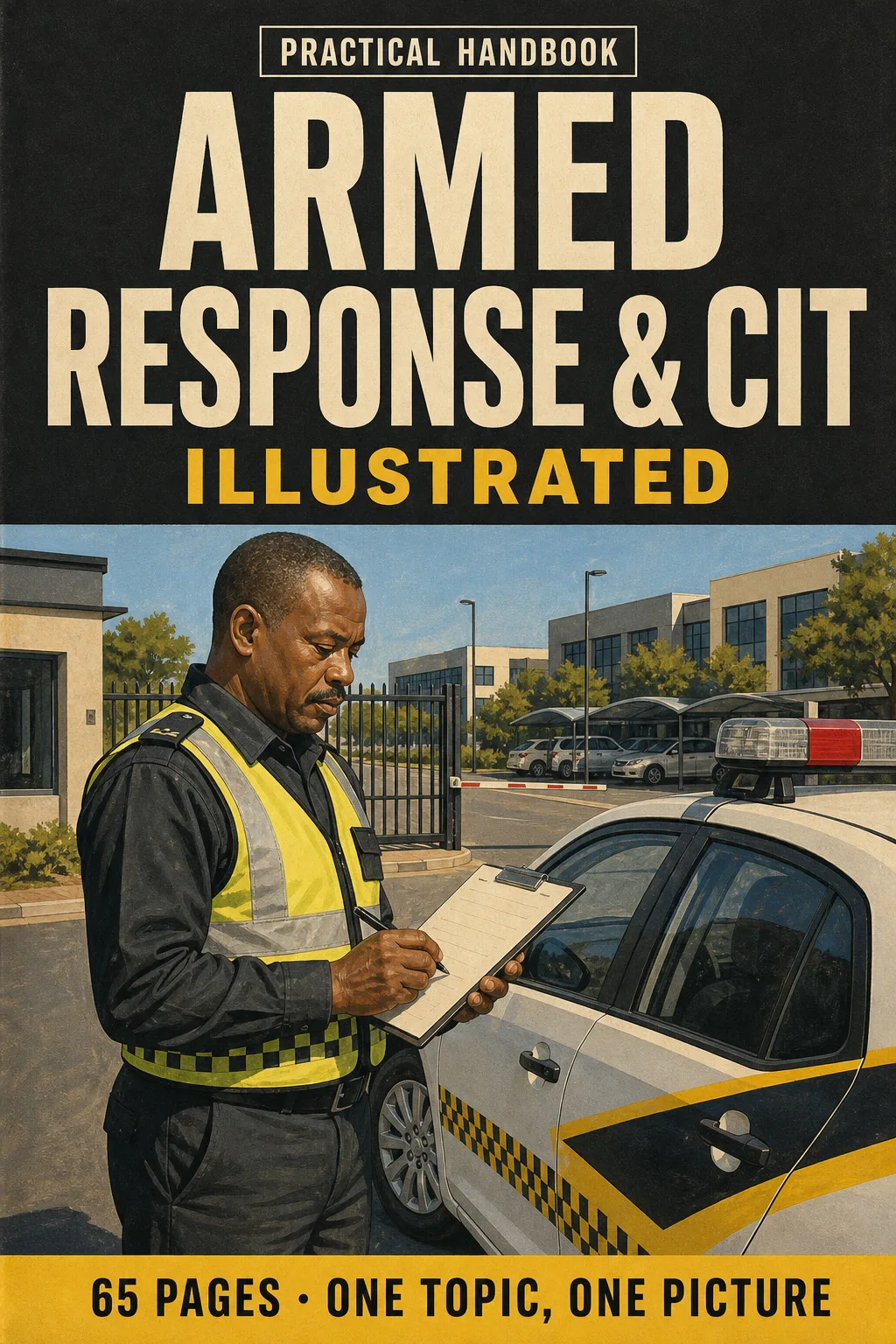
Armed Response, CIT and South African Law in Drawings Every Call in the Same Order

The alarm call, the approach drawn from above, radio procedure, use-of-force law, Section 42 arrest, firearm safety, the crime scene and the cross-pavement carry. Each topic has its own page: the drawing first, then what you need to remember. 65 illustrated pages.

START STUDYING THIS WAY

🔒 Secure checkout · PDF by email · 30-day guarantee

Every topic, its own pageEach procedure drawn, with the explanation beside it
65 illustrated pages8 parts, from leaving the gate to the start-of-shift checklist
Up-to-date sourcesPSIRA Act 56 of 2001, Firearms Control Act 60 of 2000 and Criminal Procedure Act 51 of 1977
PDF by emailFormat

Look Inside the Book

Every page has one big drawing and a box with the steps, numbers and legal points you need to know:

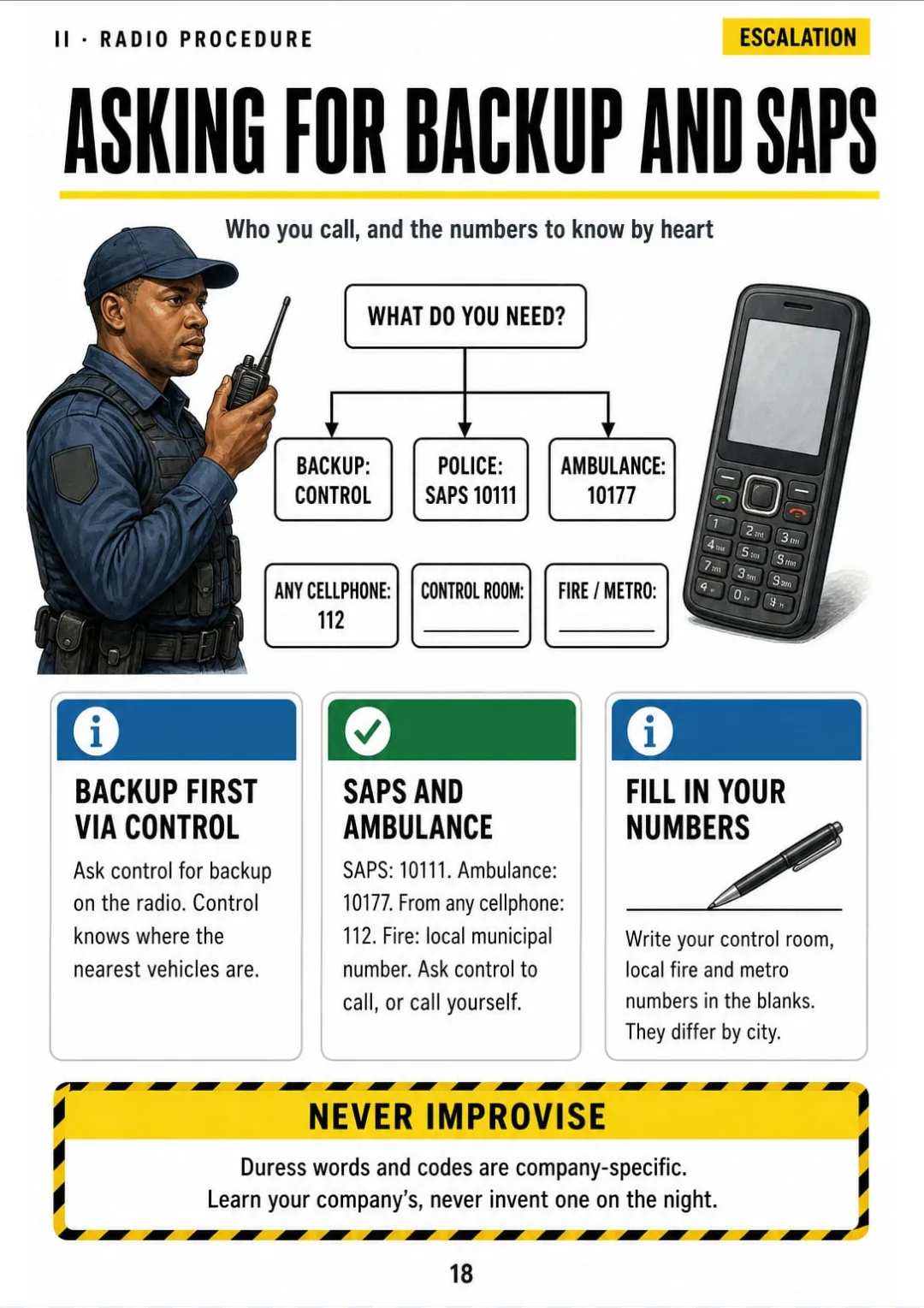
SAPS 10111 · ambulance 10177 · 112 from any cellphone
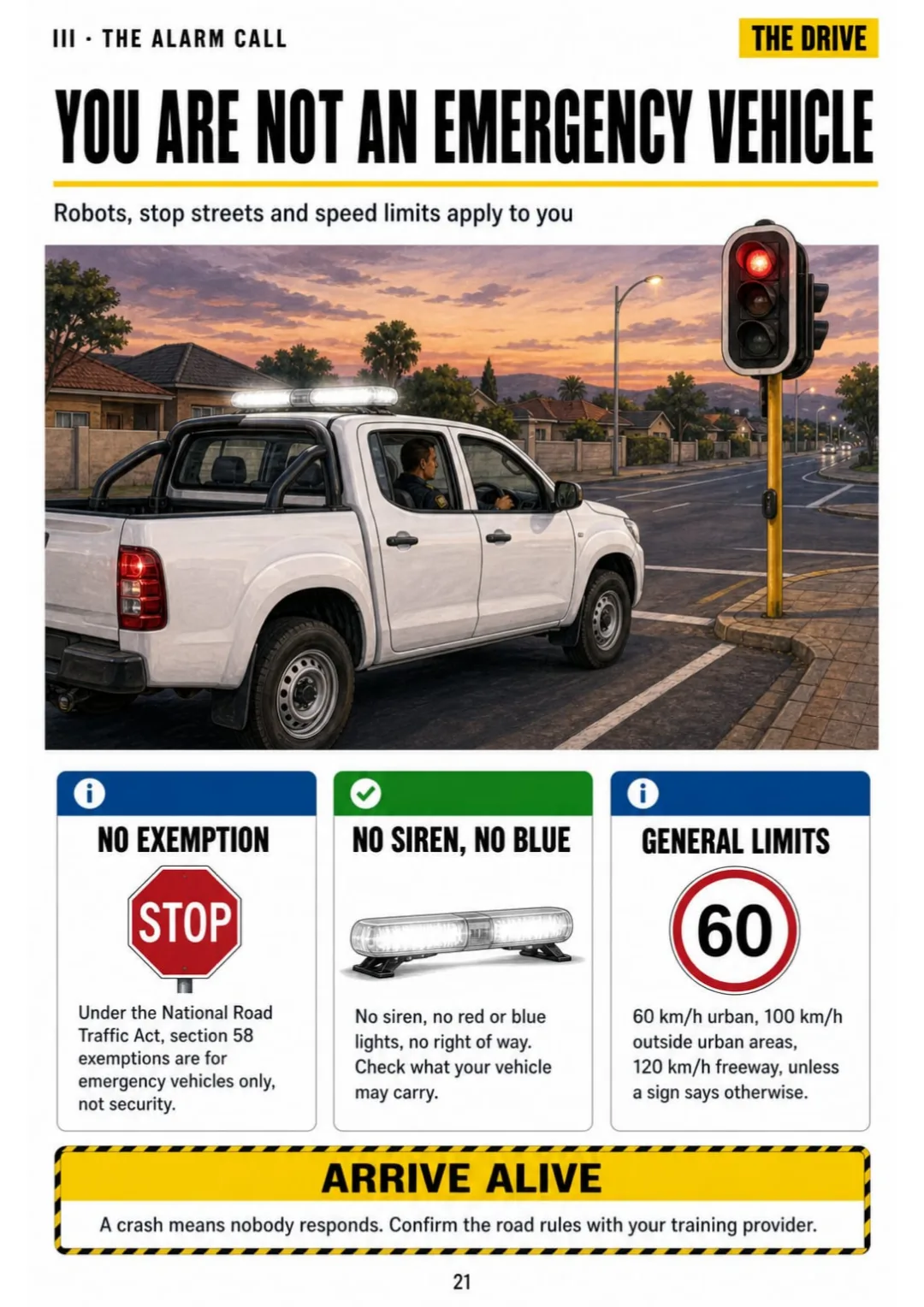
Security vehicles have no emergency exemption under the NRTA.
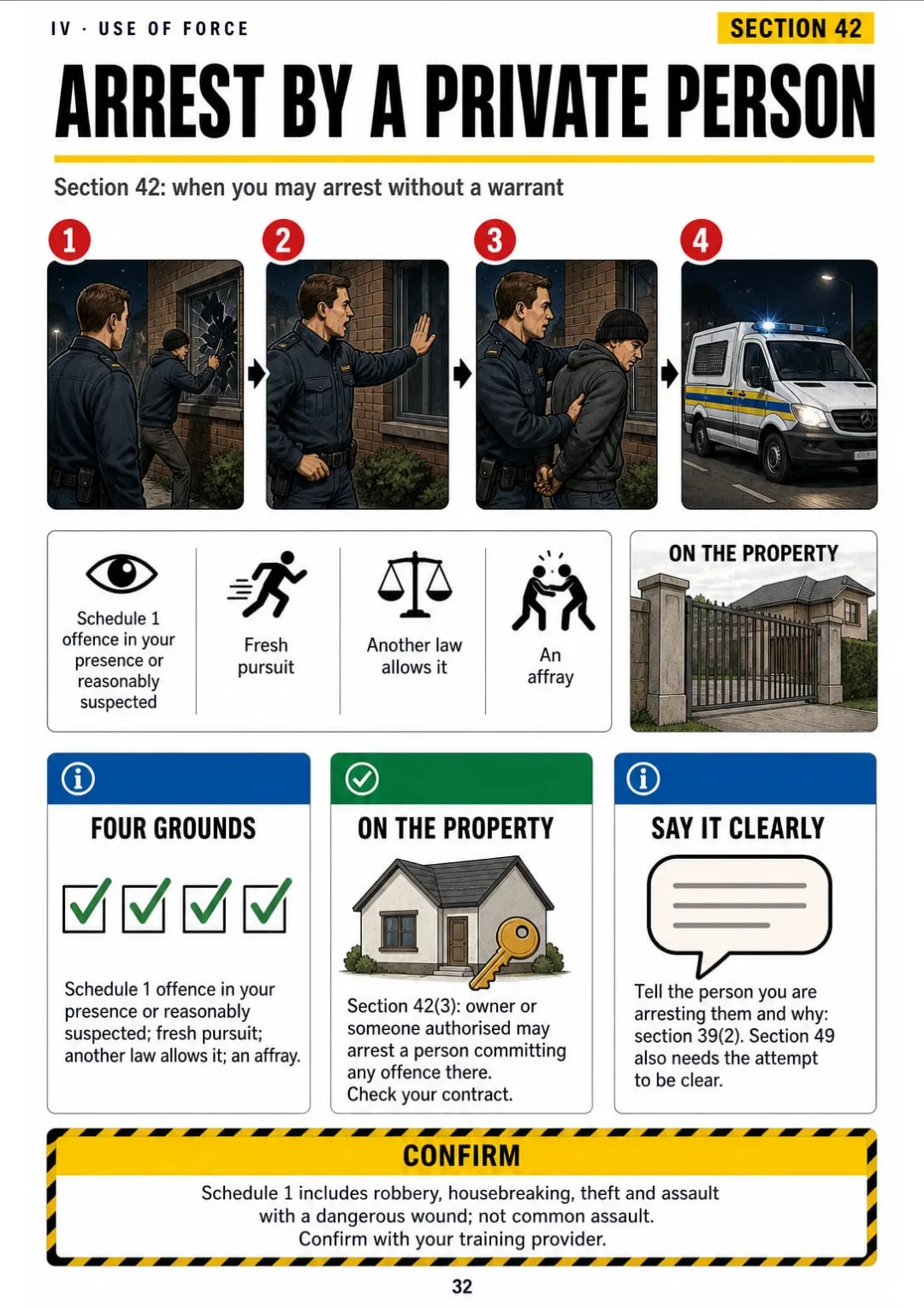
Section 42: Schedule 1 offence seen or reasonably suspected, fresh pursuit, another law, or an affray.
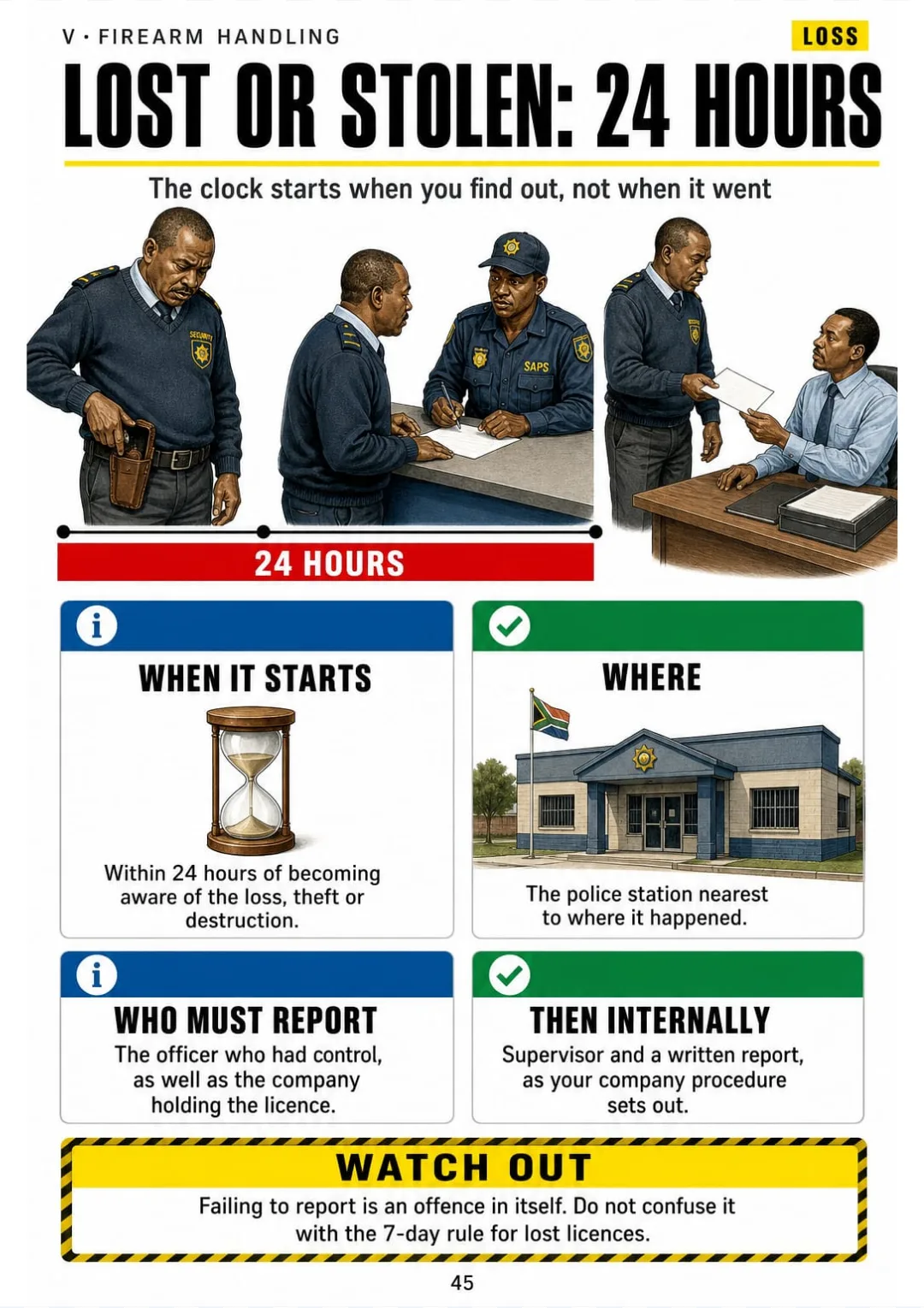
Lost or stolen firearm: report to the nearest SAPS station within 24 hours
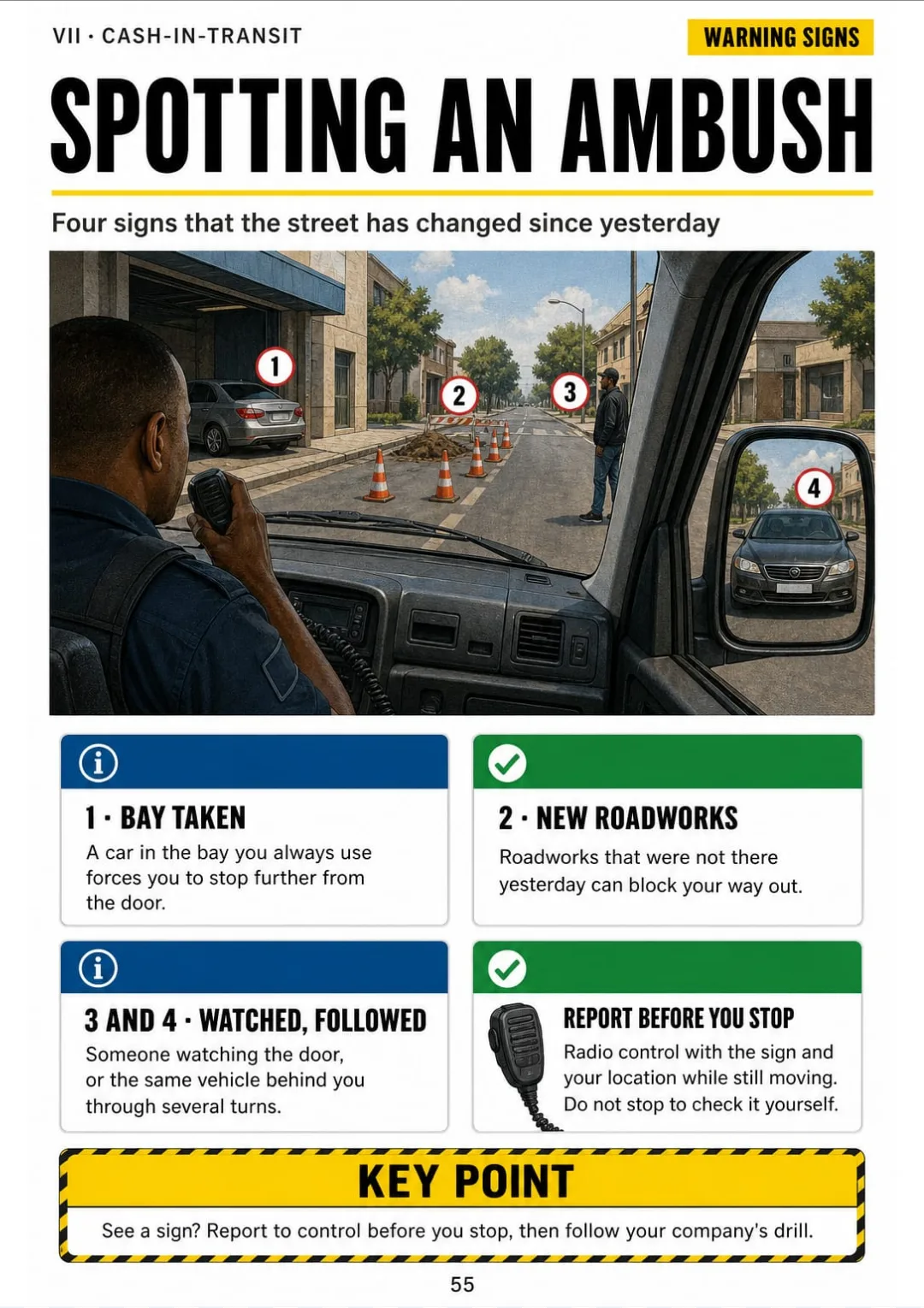
Bay taken, new roadworks, a watcher, a follower: report to control before stopping
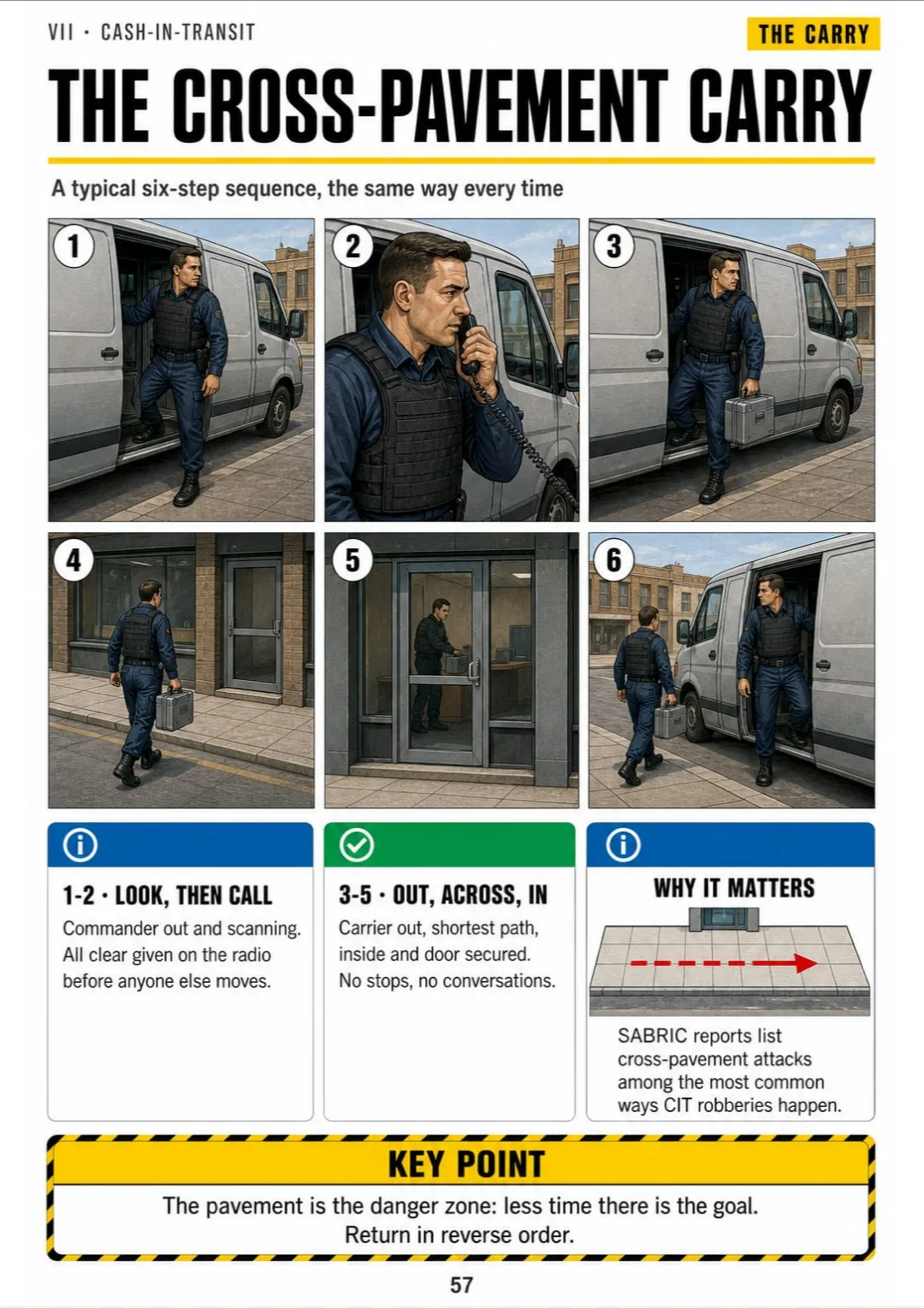
Commander out, all clear, carrier out, shortest path, door secured, return in reverse
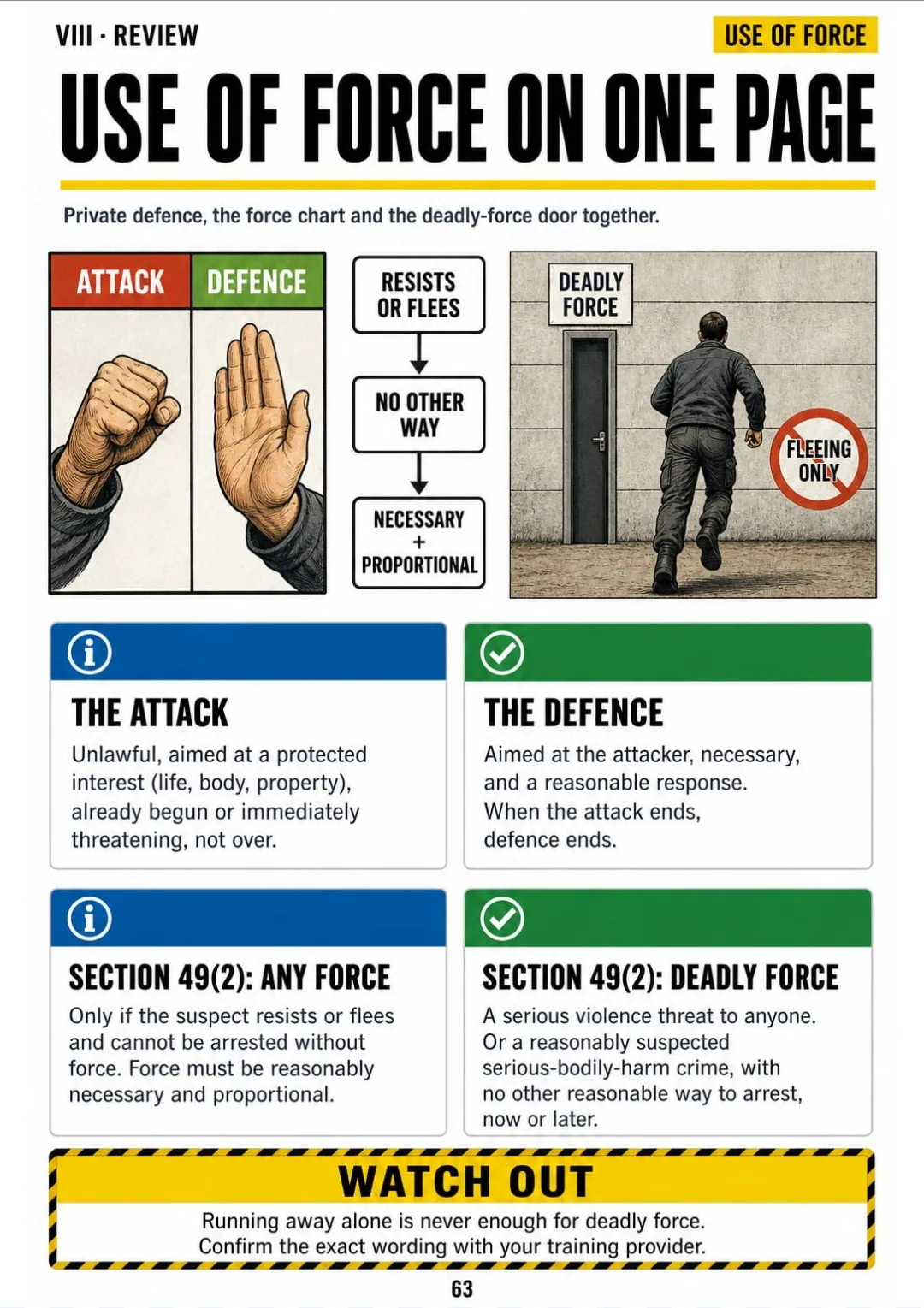
The four conditions, section 49(2) and the deadly-force door on one page
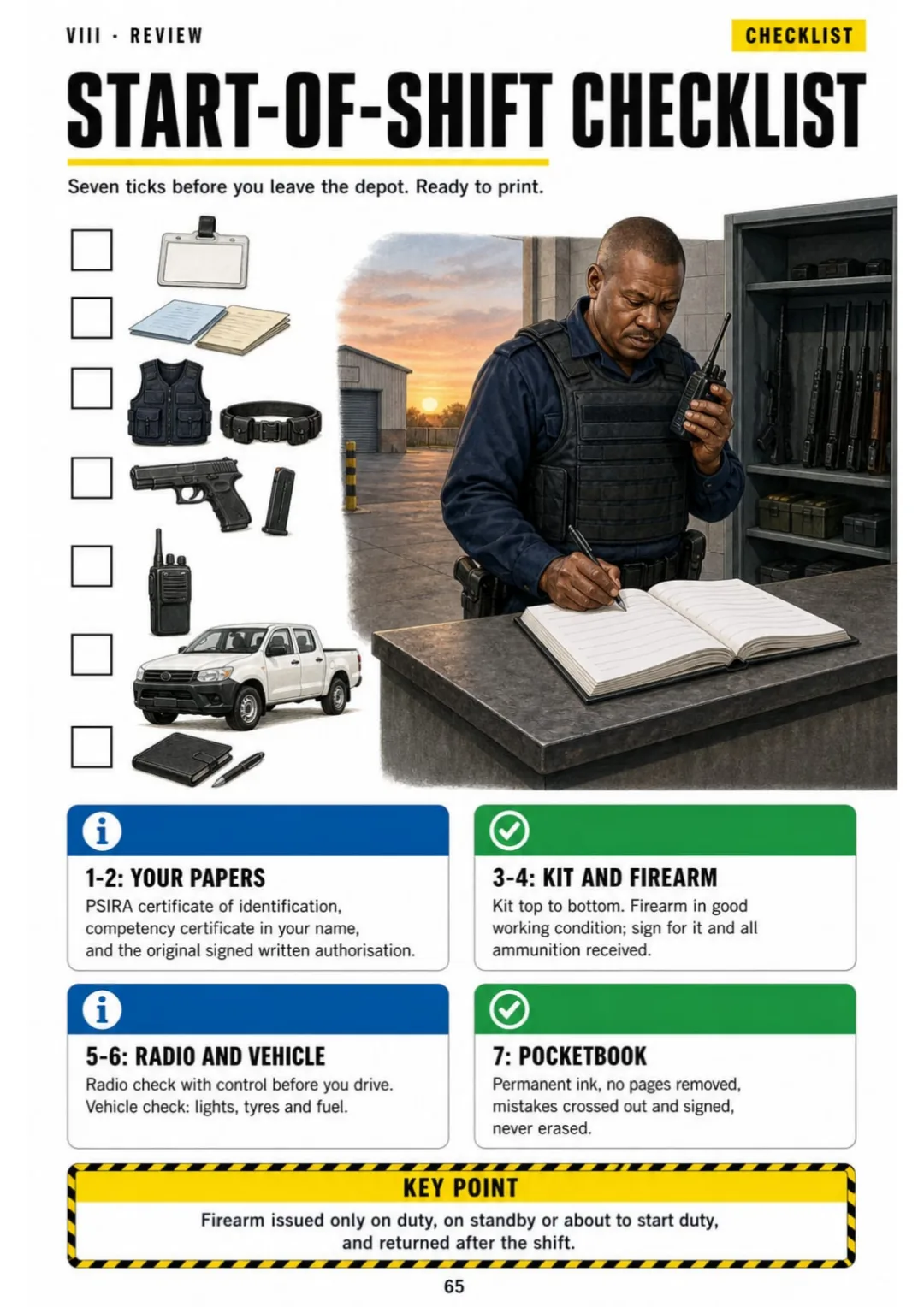
Papers, kit, firearm, radio, vehicle and pocketbook in 7 tick boxes

Swipe to see more →

These are real pages from the book. The table of contents is the full one: 8 parts and 61 topics.

The Problem Isn't You. It's How It Was Explained to You.

You're on the course and the instructor reads out a scenario: a man runs out of a shop with goods and you saw it happen. Can you arrest him, or not?

You've read Section 42 in the manual. But it's one long paragraph of "any person whom he reasonably suspects", and the four grounds blur into one.

Section 42: Schedule 1 offence seen or reasonably suspected, fresh pursuit, another law, or an affray.

In the book, arrest by a private person is one page: four grounds, each in its own drawn box. A Schedule 1 offence seen or reasonably suspected, fresh pursuit, another law, an affray.

The same goes for the approach drawn from above, the cross-pavement carry, the four safety rules and a lost firearm reported within 24 hours: each one on its own page.

Next time a scenario comes up, you picture the four boxes and answer, without going back to the manual.

COMPARE FOR YOURSELF

The Same Topic, Two Ways to Study It

THIS
  • The manual: line after line
  • Approaches explained only in words
  • You arrive on the course still unsure
On arrival at the premises, and having positioned the vehicle at a suitable distance short of the entrance, the officer shall, following an adequate period of observation, proceed towards the building in a manner that minimises exposure, making use of available walls, structures and other forms of cover, moving from one point of cover to the next, while any torch employed shall be held away from the body so as not to indicate the officer's position, after which the perimeter shall be inspected in accordance with company procedure.
FOR THIS
  • The approach in one drawing from above
  • The steps in a numbered box
  • You see it and you get it
Security vehicles have no emergency exemption under the NRTA.
CONTENTS

Take a Look at the 8 Parts and 61 Topics

From the gate to the reaction vehicle, radio procedure, the alarm call, use of force and arrest, firearm handling, the crime scene, cash-in-transit and a final review: 65 pages, all illustrated

IFrom the gate to the reaction vehicle · pp. 5-11
  1. What changes when you leave the gate
  2. PSIRA registration and your grade
  3. The Code of Conduct in five duties
  4. Your legal powers: the same as any citizen
  5. Firearms Control Act: the two documents you need
  6. Your pocketbook and the occurrence book
  7. Your kit, checked in the same order
IIRadio procedure · pp. 12-18
  1. Think, press, pause, speak
  2. The phonetic alphabet
  3. Prowords that save airtime
  4. The structure of every call
  5. Giving a location so they find you
  6. The situation report in five lines
  7. Asking for backup and SAPS
IIIThe alarm call · pp. 19-28
  1. The alarm call as one flow
  2. Taking the dispatch
  3. The drive: you are not an emergency vehicle
  4. Stop short, never at the gate
  5. Positioning the vehicle
  6. Observe before you get out
  7. The approach drawn from above
  8. The perimeter check, one direction
  9. Signs of forced entry
  10. Closing the call: false alarm or open door
IVUse of force and arrest · pp. 29-37
  1. Private defence: the four conditions
  2. Proportionality: the scale drawing
  3. The force decision chart
  4. Arrest by a private person
  5. Deadly force: the narrow door
  6. Restraint and handcuffing safely
  7. What you may not do after an arrest
  8. Handing over to SAPS
  9. After any use of force: report
VFirearm handling · pp. 38-46
  1. The four safety rules
  2. Signing the firearm out
  3. The safe loading and unloading point
  4. Holster, draw and retention
  5. Clearing a stoppage
  6. Carrying in the vehicle
  7. Storage: the safe
  8. Lost or stolen firearm: 24 hours
  9. After a shot is fired
VIThe crime scene · pp. 47-51
  1. Life first, then the scene
  2. Cordon: one way in, one way out
  3. The scene log
  4. Do not touch: the common slips
  5. Your statement in the right order
VIICash-in-transit · pp. 52-61
  1. The crew and who does what
  2. Before leaving the depot
  3. Routes and times that change
  4. Spotting an ambush
  5. Arriving at the client
  6. The cross-pavement carry step by step
  7. Cash containers and dye
  8. Seals, bags and paperwork
  9. If the crew is attacked
  10. After an attack
VIIIReview before the course and the shift · pp. 62-65
  1. The alarm call on one page
  2. Use of force on one page
  3. Numbers and words to know by heart
  4. Start-of-shift checklist

One Page, One Topic, All Clear

Think of it this way:

Two in the morning, a warehouse alarm. You pull up and you need to know where to stop, how to move and what to say on the radio.

In the book you open the approach page and see it from above: the walls, the points of cover, the torch held away from your body.

Bay taken, new roadworks, a watcher, a follower: report to control before stopping

The same with the alarm call in 10 steps, Section 42 arrest, the four conditions of private defence, the signs of an ambush and the cross-pavement carry: each one on its own page.

Armed Response & CIT Illustrated is 8 parts and 61 topics, all drawn, with one-page reviews at the end and two free books: practice questions and the 15 most common field mistakes.

What you see drawn, you don't have to memorize.

What's Inside Armed Response & CIT Illustrated:

Ipp. 5-11

From the gate to the reaction vehicle

What changes when you leave the gate, PSIRA registration and your grade, the Code of Conduct, your legal powers, the two firearm documents, the pocketbook and your kit.

IIpp. 12-18

Radio procedure

Think, press, pause, speak; the phonetic alphabet, prowords, the structure of a call, giving a location, the situation report and calling backup and SAPS.

IIIpp. 19-28

The alarm call

The alarm call as one flow: dispatch, the drive, stopping short, vehicle position, observing, the approach, the clockwise perimeter, forced entry and closing the call.

IVpp. 29-37

Use of force and arrest

Private defence, proportionality, the force decision chart, Section 42 arrest, deadly force, safe restraint, what not to do after an arrest, the SAPS handover and the report.

Vpp. 38-46

Firearm handling

The four safety rules, signing out, the loading and unloading point, holster and retention, stoppages, the vehicle, the safe, a lost firearm and what happens after a shot is fired.

VIpp. 47-51

The crime scene

Life first, the cordon with one way in and out, the scene log, the common slips and your statement in the right order.

VIIpp. 52-61

Cash-in-transit

Crew roles, the depot, changing routes, ambush signs, arriving at the client, the cross-pavement carry, containers and dye, seals and paperwork, and what to do during and after an attack.

VIIIpp. 62-65

Review before the course and the shift

The alarm call and use of force on one page each, the numbers and words to know by heart and the start-of-shift checklist.

At the end of the book: One-page reviews of the alarm call and use of force, the key numbers and a start-of-shift checklist.
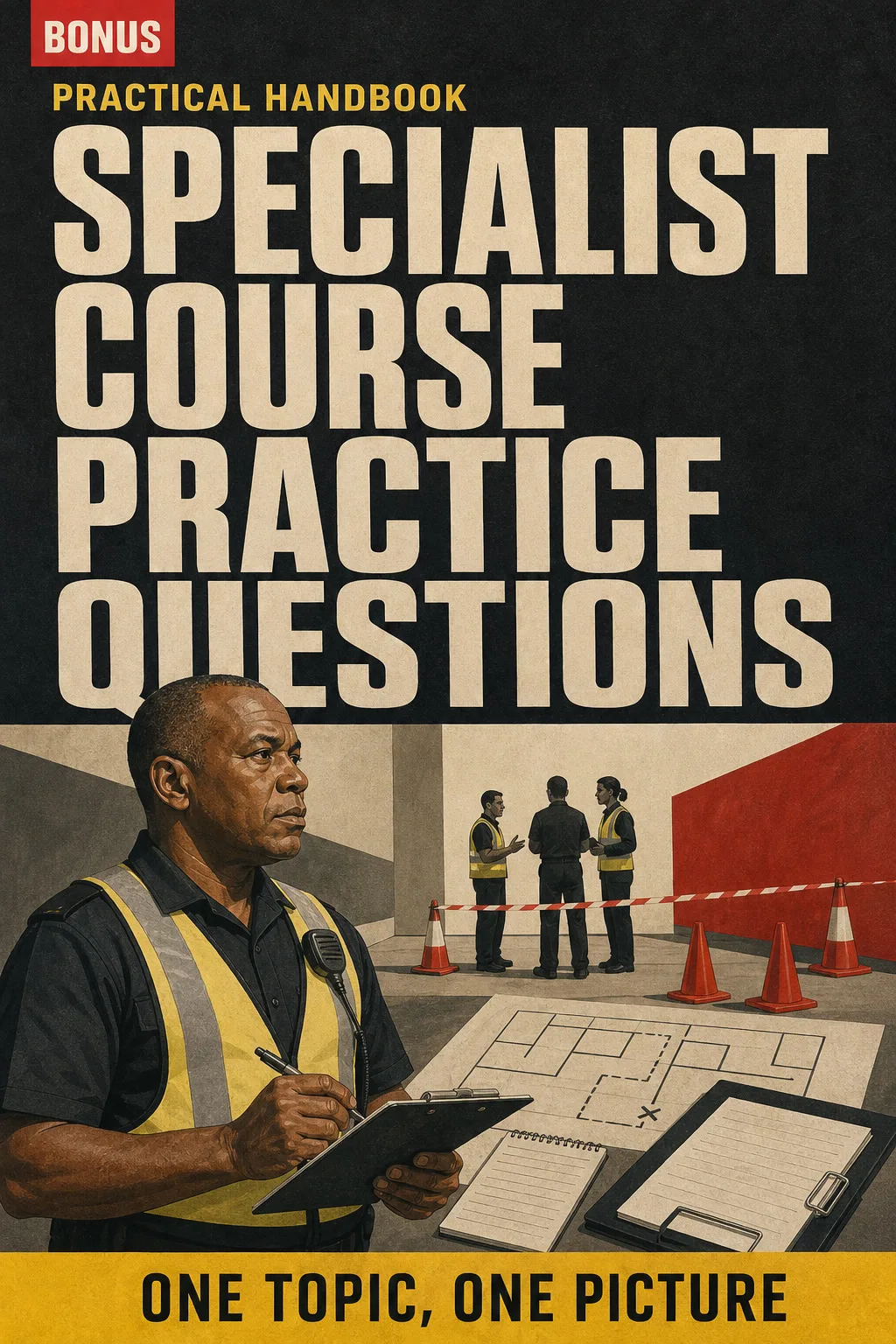
Plus: 2 Free Books

Specialist Course Practice Questions

BONUS 1: «Specialist Course Practice Questions»

Value on its own: US$ 17.90

Exam-style questions on alarm response, use of force, firearm handling and cash-in-transit, with the answer and the reason behind it, so you know where you stand before the course assessment.

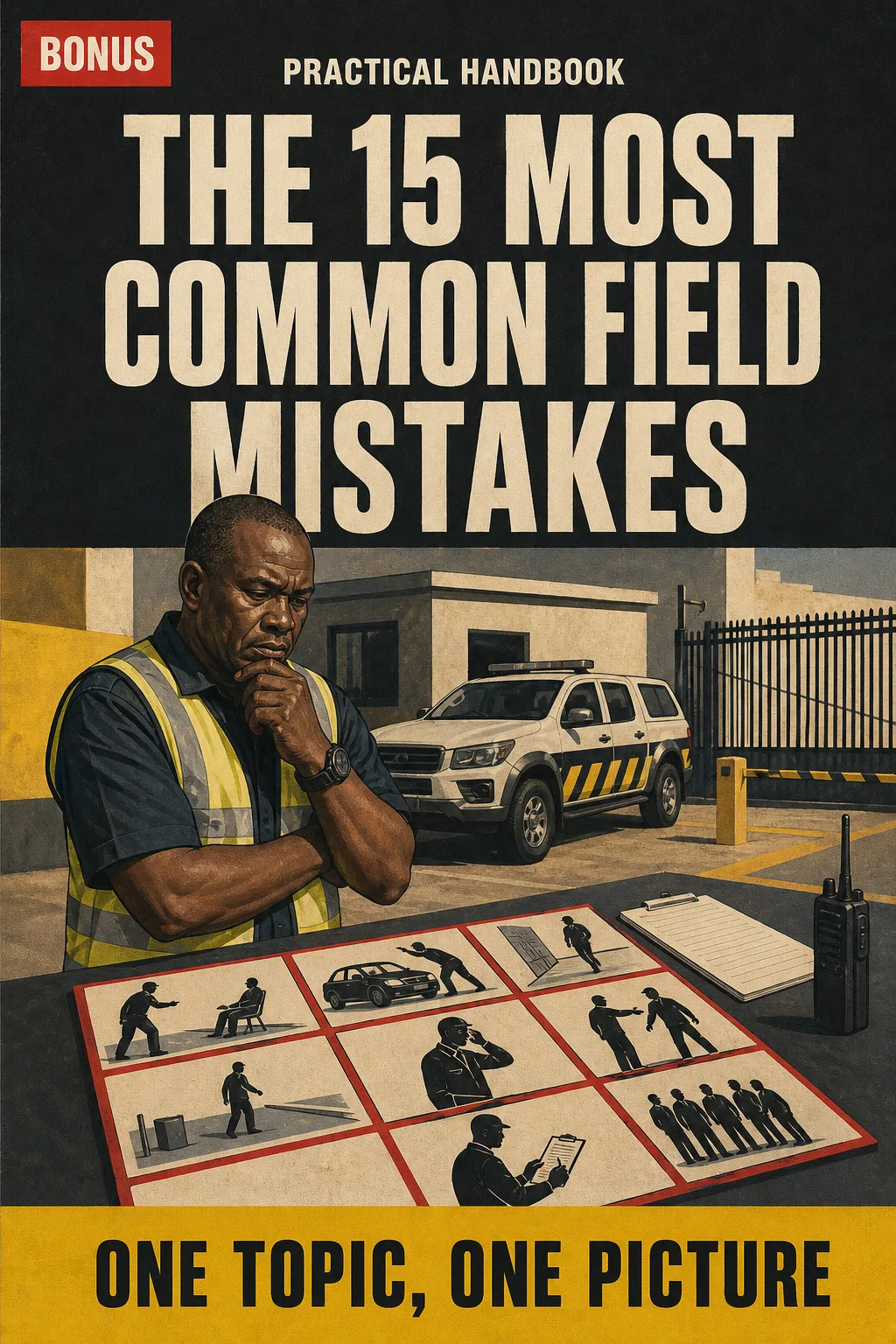
The 15 Most Common Field Mistakes

BONUS 2: «The 15 Most Common Field Mistakes»

Value on its own: US$ 14.90

Each frequent mistake drawn before and after, from parking at the gate to touching the scene, so you can go over them at a glance before your shift.

Armed Response & CIT Illustrated with 2 Free Books

  • Armed Response & CIT Illustrated: 65 illustrated pagesUS$ 63
  • BONUS 1: Specialist Course Practice QuestionsUS$ 17.90
  • BONUS 2: The 15 Most Common Field MistakesUS$ 14.90
  • High-resolution PDF to printIncluded
Total value US$ 95.80
YOUR PRICE:
US$ 27
You save US$ 68.80
YES, I WANT ARMED RESPONSE & CIT ILLUSTRATED FOR US$ 27

📄 This is a digital PDF book sent to your email: nothing is printed or shipped.

Secure purchaseEncrypted payment30-day guarantee

PDF by email: We email you Armed Response & CIT Illustrated as a PDF, together with the two free books. It's a single payment: no installments, no extra charges.

Who This Book Is For

You're studying for the specialist course

You're studying for the specialist course

Every course topic on its own drawn page, so you go over the law, radio and drills in order instead of loose notes.

Your course assessment is close

Your course assessment is close

The one-page reviews and the practice questions show you where you stand before the instructor asks.

You already work reaction or CIT

You already work reaction or CIT

Print the alarm call page for the vehicle and go over the carry or the arrest grounds before your shift.

Everything You Get Today

US$ 95.80US$ 27
YES, I WANT ARMED RESPONSE & CIT ILLUSTRATED FOR US$ 27

📄 This is a digital PDF book sent to your email: nothing is printed or shipped.

30DAYS
GUARANTEE

30-Day Guarantee

Try Armed Response & CIT Illustrated for 30 days, bonus books included.

We refund everything if the file won't open, if the book isn't what you see here, if you were charged twice or if the email doesn't arrive. Just email us.

You pay once. No subscriptions.

Frequently Asked Questions

Is it for me if I've worked years as a Grade C officer and I'm moving to armed response or CIT?

Yes. It doesn't explain security from zero: it builds on what you know from the gate and lays out the new procedures, the law and the drills in order, one page each.

Where does the content come from?

From current South African legislation: the Private Security Industry Regulation Act 56 of 2001 and its Code of Conduct, the Firearms Control Act 60 of 2000, the Criminal Procedure Act 51 of 1977 and common-law private defence. Each legal page names the Act and section it comes from, explained in our own words and drawings, so you can check it against your course manual.

Is it official material?

No. It's an independent study book, not affiliated with or endorsed by PSIRA, SAPS, SASSETA or any training provider.

Will it contradict my course or my company, and does it give me a certificate?

No certificate: it's a study book. You still need the accredited course, its assessment, your firearm competency and your company's procedures, and it isn't legal advice. The law is the same for everyone; where your company does a drill differently, follow your company.

Are the practice questions the ones in the assessment?

No. They're written for this book, in the style of a course assessment, with the answer and the reason behind it.

When and how do I get it?

PDF by email, to the address you enter at checkout, together with the 2 free books.

Do I have to pay every month?

No. It's a one-off payment.

Can I have it on paper?

Yes. The PDF is ready to print at home or at a print shop, so you can keep it in your shift bag.

How does the refund work?

You have 30 days. We refund everything if the file won't open, if the book isn't what you see on this page, if you were charged twice or if the email doesn't arrive: just email us.

Before You Close This Page

No more rereading the manual with nothing sticking.

The approach and the arrest grounds: you see them drawn and that's it.

You arrive on the course knowing where everything is.

Drawings make studying faster.

The book is right below.

One-time payment: US$ 27 · Guarantee: 30 days · PDF by email

YES, I WANT ARMED RESPONSE & CIT ILLUSTRATED FOR US$ 27

📄 This is a digital PDF book sent to your email: nothing is printed or shipped.